Archive for the ‘Ecuador Travel Advice’ Category
Ecuador Eco Volunteer is now working with Kingdom Kichwa Hostel Quito.
The reason we have decided to work with this hostel in Quito is because we think its important to support and promote Ecuadors indigenous people.
This is not only true with our many volunteer programs but also for our ecotourism trips which help secure an alternative source of income for indigenous families and communities.
Kingdom Kichwa Guesthouse
Kingdom Kichwa Guesthouse will give you a taste of that authentic Kichwa Hospitality in the middle of Quitos Mariscal or “Gringolandia” – the cities nightlife and restaurant district.
The features and services offered at Kingdom Kichwa House include:
- friendly welcoming atmosphere
- fully equipped kitchen
- beer garden out back
- chillout area with fireplace
- comfortable beds
- super fast wifi
- hot showers
The hostel is also located close to the Ministerio de Relaciones Exteriores making it the perfect place if you are extending your tourist visa.
I am living in the hostel at the moment which means I can give newly arrived volunteers a detailed heads up about their upcoming volunteer experience with us.
After three years of absence Ecuadors famous Nariz del Diablo train has finally returned to Riobamba!
Here you can check out the routes as well as the Train Timetable and Prices
It has taken years and billions of dollars to renovate the old train tracks designed at the turn of the 19th century for steam engines.
Unfortunately being able to ride on the roof of the train, one of the biggest drawcards for tourists, is no longer possible with the new modern carriages. The reason may be due to why the Nariz del Diablo train closed down in the first place: the deaths of two Japanese tourists whose heads were accidentally severed when some thoughtless dumbass installed a cable over the train tracks.
The interesting thing about the inauguration was that the governor of Chimborazo Province gave the speech instead of the mayor of Riobamba, Juan Salazar, who is widely perceived as corrupt. This sparked a rumour that Juan Salazar is “quemado” or “burnt” and other politicians now consider it to be a liability to associate with him as well as the belief he may be removed from power soon.
This is fantastic news for the people of Riobamba who believe the mayor has plundered the city for too long, and it gives kudos to the innovative social media campaign against him called Caos en Riobamba Sr. Salazar.
The Problem with Paradise
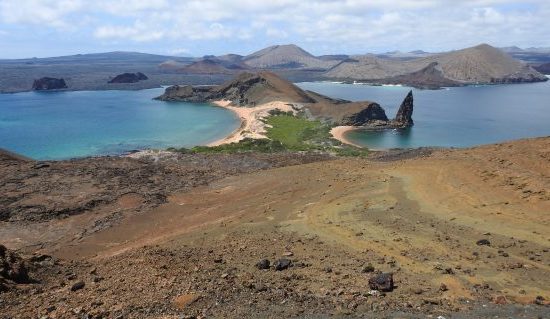
The Galapagos Islands is not only the most famous tourist site in Ecuador but also one of the most well known and visited vacation destinations in the world. Those that have visited the Galapagos will have no doubt in their minds the reason behind its popularity.
If you’ve never been and want to know if these islands live up to the hype, well lets just say the one word that I hear time and time again from people coming back from the Galapagos is this – Paradise.
However the problem with paradise is its easy to exploit.
One of the reasons the islands have such an amazing and diverse array of plant and animal life is that for hundreds of millions of years they have never hosted the worlds most deadly predator – the human being – until now.
Environmental Issues on the Galapagos Islands
The 18th century socioeconomist Thomas Robert Malthus stated that the increase in human population will eventually outpace the rate in which it can feed itself. That if the human population is left unchecked then famine will become a global epidemic and consume us silly humans.
It was Malthus’ essays on Population that inspired the two grandaddys behind Evolution and Natural Selection, Charles Darwin and Alfred Wallace, to come to their own theories. If Darwin knew that today the fittest animals on the Galapagos are the Goat, Cat, the Rat, and the Human that are flourishing at the expense of everything else – he would no doubt be tossing in his grave.

- Now 200,000 humans visit the islands every year which left unchecked will rise to 400,000 by 2021.
- Now 30,000 humans have immigrated to the islands (and many more illegaly) a figure that has doubled in the last ten years and sees no sign of slowing.
- Now invasive species of rats, goats, cats, mosquitos and fire ants as well as an increase in human sewage and motor boat oil threatens the existence of the islands fragile ecosystems.
- Now “artesenal” and industrial fishing, the former to feed the large immigrant communites and tourists on the island and the latter used to sell on overseask markets, have completely wiped out fish stocks threatening animals like the Sea Cucumber that sells for a fortune in Japan and Korea with extinction
- Now introduced plants outnumber indigenous ones and 180 of the 500 native plant species are on the International Union for Conservation (IUCN) of Nature Red List of threatened species.
- Now 95 species of reptiles, birds, penguins, sea lions, seals, snakes, and mammals that live on the Galapagos Islands are endangered animals.
- Now Lonesome George, the last remaining Pinta Island Tortouise, is the rarest creature on Earth and a potent symbol for conservation efforts in the Galapagos.
Galapagos Governmental Policies to Protect the Galapagos
New regulations created by Rafael Correas government to protect the Galapagos meant in July 2010 the islands were removed from the “List of World Heritage in Danger”
This happened in despite of a strong recommendation from the International Union for Conservation of Nature to urge against removing the Galapagos Islands because it was “premature.”
The Galapagos Government now has the power to ban commercial fishing on much of the islands except for designated areas.
The Government has also tightened rules for immigration for residents from the mainland which means now at the airport many Ecuadorians en route to the islands are profiled and interrogated – Why they wish to travel to the Galapagos? For how long they are going to stay? And what happens if they find work there?
Answer any of the above wrong and they are denied travel.
All this happens while hundreds of thousands of tourists with big fat wallets pass onto the plane unimpeded – and don’t hold your breath if you think they are going to restrict foreign tourists any soon.
so how can we visit the Galapagos without feeling guilty?
Volunteering on the Galapagos Islands
The great thing about volunteering in the Galapagos is it lets you visit without leaving such a big dirty footprint. The problem however is the price.
We spent a long time researching different Galapagos Islands Volunteer Programs to promote here on Ecuador Eco Volunteer but finding that perfect program that neither breaks the bank nor compromises on quality was very hard.
There were quite a few dodgy operators running volunteer programs on the Galapagos as well. One program wanted to charge a $200 fee to “consider” the application and another wanted a full body shot of prospective female volunteers. We worked with another volunteer program that had won awards from some big names but quite a few volunteers complained and when we confronted the program administrators they claimed everything was fine and that our volunteers were lying.
In the end I decided to go there myself hoping to find some idealistic people that had the infrastructure and resources in place to set up a new Galapagos Volunteer Program from scratch. I found them!
Lets Fight to Defend the Worlds Most Vulnerable
If the cause to save the Galapagos resonates with you then you should consider checking out our new Galapagos Volunteer Program. It will take time to refine a few of the rough edges and make it great but with your help we can do that.
The future for the Galapagos Islands looks brighter than five years ago but that should not goad us into complacency. We must continue the admirable work of all the volunteers and environmental activists that have come before us to ensure our children can look at the Galapagos with the same wonder as Charles Darwin 200 years ago.
If you are flying to Ecuador there is a good chance you will be arriving in Quito Airport, also known as Quiport, and Mariscal Sucre International Airport.
Quito Airport is one of the highest airports in the world and those flying in at night are in for a treat when they see the valley of lights of Quito stretched between the Andes mountains. The airport services 6.2 million people every year and is one of two departure points to the Galapagos Islands (along with Guayaquil)
Taxis to and From Quito Airport
After leaving the airport you can save money on a taxi if you walk to the main road on the other side of lanes and parking places reserved for the airport.
From Quito Airport to the Mariscal, one of the most popular lodging places for tourists in the city, a taxi costs $5 and takes about 20 minutes without traffic.
A great place to stay in the Mariscal that is two blocks from the Plaza Foch is Kingdom Kichwa Guesthouse. The hostel is run by indigenous Kichwa which gives curious travelers an interesting insight into the first people of Ecuador.
To the Terminal Quitumbe, or South Terminal Bus Station (where many buses leave for Riobamba, Cuenca, Guayaquil, Coca and most other places in Ecuador) expect to pay around $15 for an hour ride without traffic. Quitos Northern Bus Terminal costs about $2 in taxi but services only a select few places like Mindo.
Safety in Quito
Quito can be a dangerous city especially in the night. Use your common sense and stick to highly populated places and don’t wander down dark deserted alleyways. It is recommended you book accommodation before you fly in instead of searching for a place when you get here.

Ive applied for and renewed my tourist visa a number of times over the years in Ecuador and I can tell you passing through the bowels of Ecuadorian bureaucracy is about as fun as passing a kidney stone.
The majority of countries can enter Ecuador without a visa for up to 90 days. If you wish to extend your trip for another 180 days the best visa to get is the 12-IX / 12-9 tourist Visa.
The process of applying for a 12-IX Visa is much faster now than in previous years and if you follow these tips ive learned from trial and error you will save yourself hours.
Follow this link for advice if you have overstayed your visa in Ecuador.
Complete the Paperwork the Day Before
– This article was written in April of 2012 and the steps to apply for a tourist visa may have changed since then. Check this page on the Ministerio de Relaciones Exteriores website for the most up to date requisites for the tourist visa.
- There is no way you will be able to complete the paperwork the same day as you apply for the visa. Save yourself a tonne of time and hassle by printing out the following papers the day before.
– Check that your passport is valid for at least six months in the future and make two photocopies of it.
- Have a photocopy of a flight ticket or bus ticket leaving the country. My return flight to Australia was from Argentina a year into the future which was accepted as a legitimate “proof of onward travel”
- Print out your bank account balance to prove you have solvency to stay in the country. This can be as easy as doing a print screen on your netbank account on the internet. Im not sure what the minimum amount of money in the bank is required but if you are worried you may not have enough its easy to fudge the numbers in photoshop.
- Download and print out a couple of copies of the Solicitud de Visa. Trust me its better to have a few of these forms spare than to make a mistake then have to run to the nearest cyber cafe and have to print it out again.
- Get some passport sized photos with a white background and remember not to smile. They do not like smiles in the Ministry of Exterior Relations. Bring some glue to stick the passport photo onto your Solicitud de Visa.
- The final thing that you can do on the day that you get the visa is the “Petición escrita” or Written Petition. You can get this printed out in about 5 minutes for 25 cents at the Cyber Cafe called COMPUWORLD down some stairs to the left of the front door of the ministry of Exterior Relations. Id recommend that you do not do this until you already have a Turno or Ticket with a number on it securing your place. The letter looks like this “Yo, John Smith, con passaporte numero M1234567, quiero aplicar para la visa 12-IX para realizar turismo en Ecuador.” with your name and signiture underneath.
How to Apply for a Tourist Visa in Ecuador
You can apply for a Tourist Visa in Ecuador in Quito and Guayaquil. The following will be a step by step process on how to apply for the visa Quito because ive only ever been to the Ministry of Exterior Relations there.
Step 1: Save yourself a few hours by waking up early and going to the Ministerio de Relaciones Exteriores between 7 and 7:30am.
Even by 7:30 there will be a long line outside the ministry but if you arrive any later you will have to wait a few hours longer or even have to come back the next day because they may not have time to attend you.
TIP: The best hostel to stay in the night before applying for a tourist visa is Kingdom Kichwa Guesthouse which is four blocks from the Ministerio de Relaciones Exteriores.
Step 2: You will be given a ticket with a number on it when you arrive inside. If you get in early the guards will tell you to go upstairs at around 8:30 where you wait on the second floor for your number to be read out. If you arrive after 8 you will have to wait downstairs for a few hours until the first group upstairs have been processed.
Step 3: When upstairs wait for your number to be read out then go to the immigration officer and give them the completed forms and papers. Be nice and courteous because these guys have to deal with frustrated foreigners all day and they also have the power to reject your visa application and make life hell for you.
Step 4: If you have completed the form correctly and have all of the documents mentioned above the immigration officer should give you a ticket to pay $30 for the Visa Application. Go down to the bottom floor and there should be a place up end of the room that says “Caja” which means cash register. Pay the $30 there and he will give you a receipt which you need to take upstairs.
Step 5: Once you have the receipt for the $30 you will be able to skip the queue in the upstairs room and take it straight back to the immigration officer who served you. He or she will then take a photo of you which will be printed out onto a sheet which you have to carry around for the week that the Ministry retains your passport. The officer will then give you a date for when you have to come back to the Ministry.
Step 6: After a week or so go back to the Ministerio de Relaciones Exteriores at around 3pm in the afternoon and pick up your passport and shiny new visa!